
Most people think tree removal is simple.
Cut the tree down. Clean it up. Job done.
And sometimes that’s true.
But many tree removals across Auckland are far more technical – especially when dealing with large dead trees in confined residential spaces surrounded by homes, fences, driveways, retaining walls, gardens, and neighbouring properties.
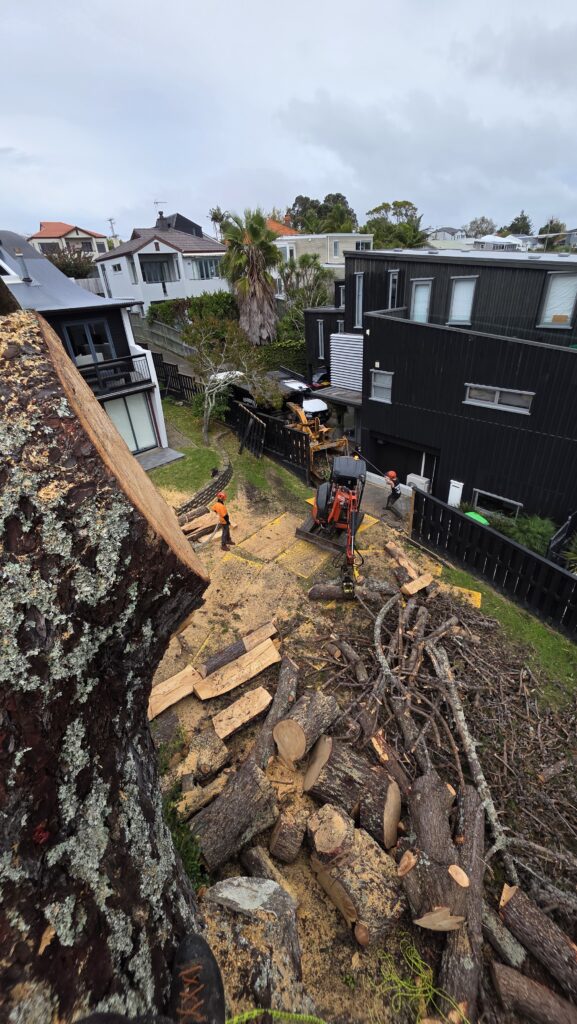
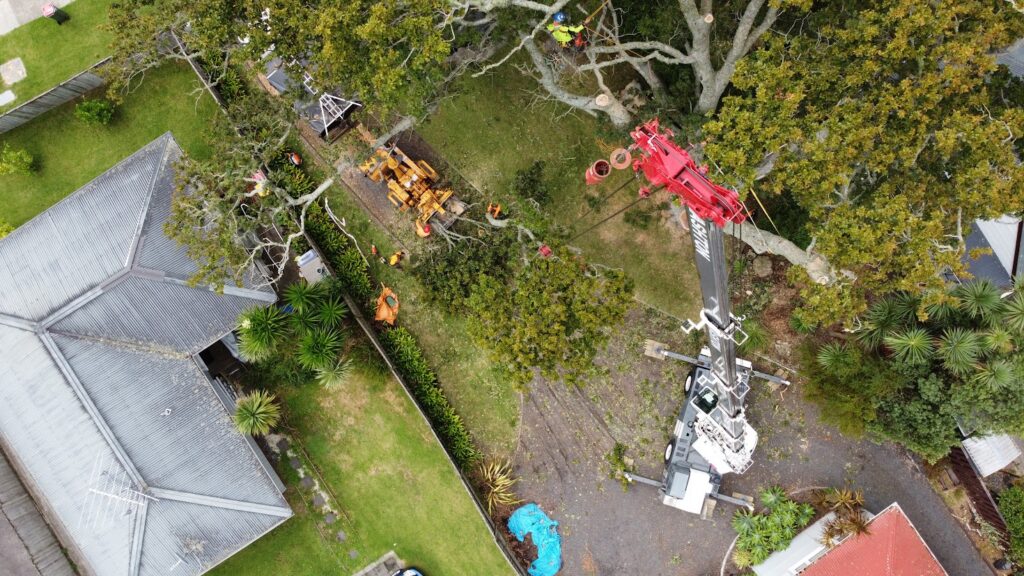
Recently, the Hardfell team completed a large dead pine tree removal in Auckland where the tree had to be dismantled piece by piece using advanced rigging systems due to extremely limited access and surrounding hazards.
From the ground, it can sometimes look like arborists are “taking their time.”
In reality, technical tree removals involve constant planning, communication, rope management, load control, and risk assessment throughout the entire dismantling process.
If you’ve ever wondered why some tree removals cost more than others – or why an arborist says a tree cannot simply be felled – this guide explains exactly why.
What Is a Technical Tree Removal?
A technical tree removal is a dismantling process where a tree cannot safely be felled from the base in one piece.
Instead, arborists remove the tree in controlled sections using:
- Rigging ropes
- Pulley systems
- Friction lowering devices
- Climbing systems
- Controlled anchor points
- Ground crew coordination
Each branch and timber section is carefully lowered into a designated landing zone to avoid damage to surrounding property.
Technical dismantling is commonly required for:
- Tight access tree removal
- Dead tree removal
- Trees near houses
- Trees over driveways
- Trees near powerlines
- Hazardous tree removal
- Large pine tree removals
- Urban Auckland properties
In residential Auckland environments, this is often the safest and only practical method of removal.
Why Dead Trees Are More Dangerous
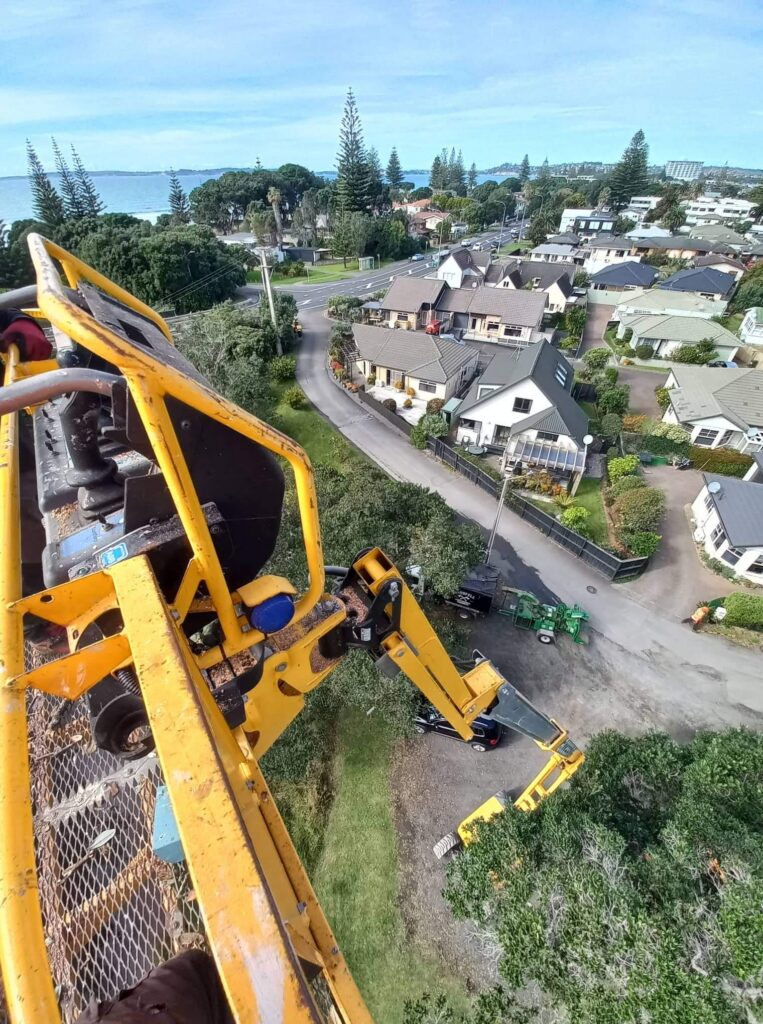
Dead tree removal is significantly more hazardous than removing healthy trees.
Dead pine trees become:
- Dry and brittle
- Structurally compromised
- Unpredictable under load
- More prone to sudden limb failure
- Unsafe for uncontrolled free-fall cutting
This changes how arborists climb and rig the tree.
One of the most common things we see during dead pine removals is homeowners underestimating how brittle the timber has become. Trees that appear stable from the ground can fail very suddenly once weight and movement are introduced into the canopy.
On this Auckland pine removal, extensive rigging was required throughout the dismantling process because dead timber can fail suddenly if overloaded or shock loaded during removal.
This meant:
- Smaller sections had to be removed
- More rope work was required
- More setup time was needed
- Additional safety controls were necessary
- The dismantling process became slower and more technical
This is one of the major reasons hazardous tree removal costs are often higher.
Why Tree Rigging Takes Time
One of the most common questions customers ask is:
“Why does rigging take so long?”
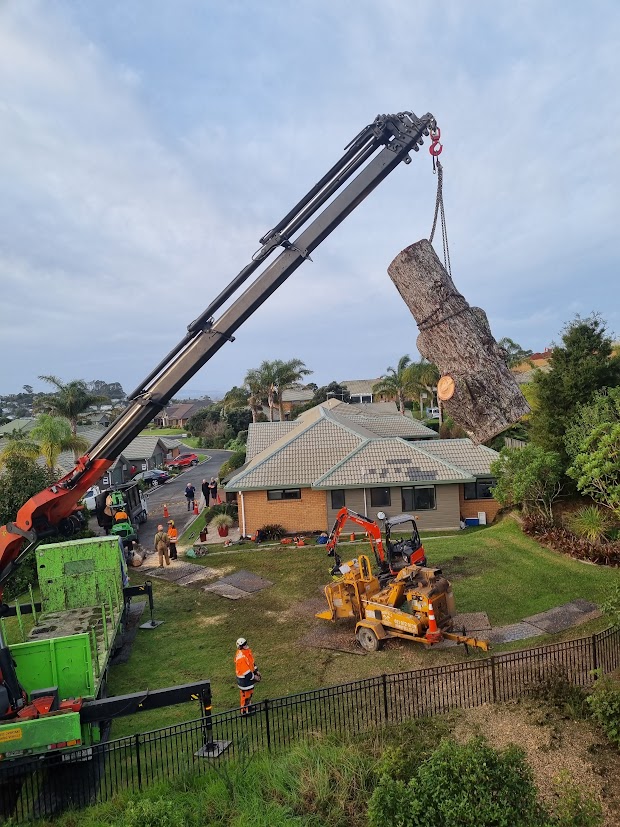
Because controlled lowering is the most important part of the removal.
The cutting itself is often the easy part.
The technical work happens in:
- Rigging setup
- Rope management
- Load balancing
- Redirect systems
- Anchor point selection
- Swing control
- Ground crew coordination
- Protecting structures below
One poorly controlled section can:
- Damage roofing
- Destroy fences
- Impact neighbouring property
- Fail rigging systems
- Injure workers
- Cause major property damage
Professional arborists work methodically because they are constantly planning several steps ahead.
That is the difference between simply “cutting down a tree” and carrying out a professional technical tree dismantle safely.
Why We Use Compact Diggers During Tree Removals
For this project, the Hardfell team used a compact digger to assist with timber handling and site operations.
Small machinery plays a major role in both:
- Safety
- Efficiency
Compact diggers help arborists:
- Move heavy timber safely
- Reduce manual lifting
- Process logs faster
- Minimise worker fatigue
- Improve productivity in confined spaces
On tight-access tree removals in Auckland, compact machinery is often ideal because larger equipment cannot safely access the site.
Especially during wet Auckland conditions where ground protection and site access become even more important.
Do Protective Mats Prevent Lawn Damage?
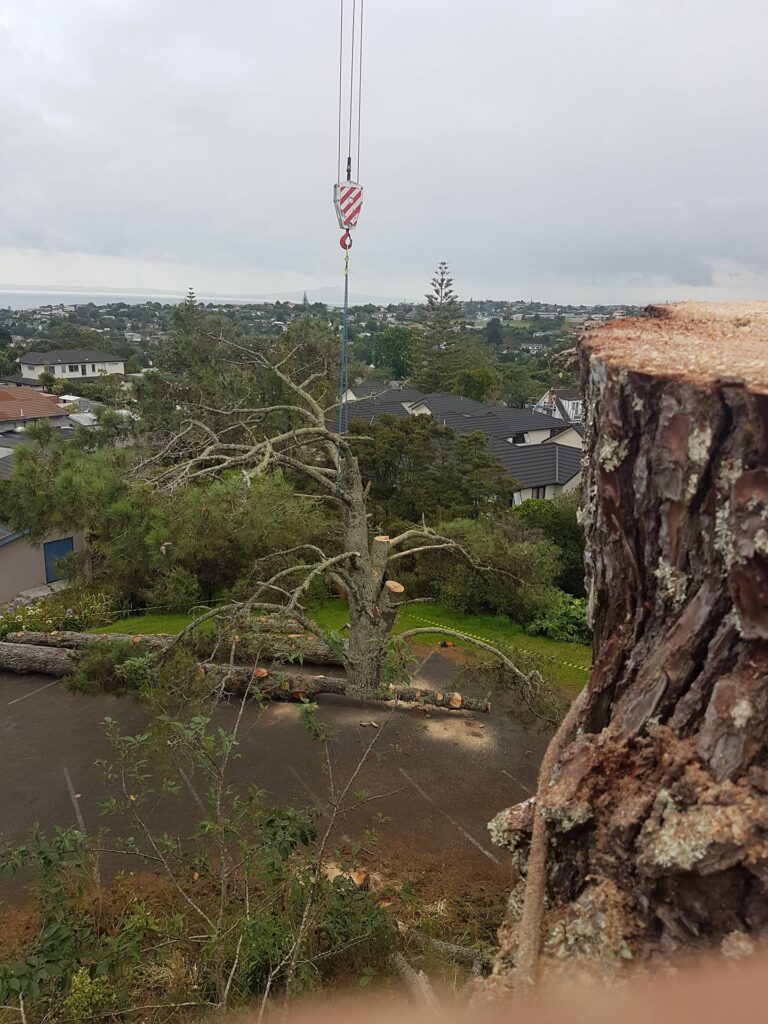
Protective ground mats make a significant difference during technical tree removals.
Without protection systems, repeated machinery movement and timber handling can quickly damage lawns and landscaped areas – especially during wet Auckland conditions.
For this removal, protective mats were installed throughout the work zone to:
- Spread machinery weight
- Reduce ground rutting
- Protect grass surfaces
- Minimise site disturbance
- Create safer access routes
While no large removal is completely impact-free, professional arborists should always take reasonable steps to protect the property wherever possible.
Why Technical Tree Removals Cost More
Technical tree removal pricing is usually influenced by:
- Tree size
- Access difficulty
- Rigging requirements
- Tree condition
- Site hazards
- Machinery requirements
- Crew size
- Time on site
- Risk level
Hazardous tree removals often require:
- Larger crews
- Advanced rigging systems
- More experienced climbers
- Additional insurance exposure
- Slower dismantling methods
- Specialised equipment
You are not simply paying for someone to cut branches.
You are paying for controlled risk management around homes, structures, and people.
In many cases, cheaper quotes are cheaper because they involve:
- Less protection
- Larger uncontrolled cuts
- Reduced safety margins
- Less experienced operators
When Should You Call an Auckland Arborist?
You should arrange an arborist assessment if you notice:
- Dead branches
- Canopy decline
- Cracking timber
- Leaning trees
- Fungal growth
- Sudden limb drop
- Root movement
- Storm damage
- Bark shedding
Dead trees can deteriorate rapidly and become significantly more dangerous during high winds and severe weather events.
The earlier a tree is assessed, the more safe removal options are usually available.
Why Choose Hardfell for Technical Tree Removal in Auckland?
At Hardfell Ltd, we specialise in:
- Technical tree dismantling
- Tight access tree removal
- Hazardous tree removal
- Dead pine tree removal
- Emergency tree removal Auckland
- Crane-assisted tree removals
- Advanced rigging operations
- Residential and commercial arboriculture
Our team regularly carries out complex tree removals across:
- West Auckland
- Rodney
- North Shore
- Central Auckland
- Wider Auckland regions
Hardfell Ltd are:
- NZARB Registered Master Arborists
- SiteWise Gold Certified
- Tōtika Prequalified
- Fully insured
- Experienced in high-risk arboricultural operations
Frequently Asked Questions
Why can’t some trees just be cut down?
Large trees near homes, driveways, powerlines, and neighbouring properties often require sectional dismantling to safely control falling material.
Are dead pine trees dangerous?
Yes. Dead pine trees become brittle and unpredictable, increasing the risk of branch or stem failure during storms and high winds.
What is tree rigging?
Tree rigging is a controlled dismantling method where arborists use ropes, pulleys, and lowering devices to safely lower sections of tree material piece by piece.
How much does technical tree removal cost in Auckland?
Pricing depends on:
- Tree size
- Access
- Rigging complexity
- Machinery requirements
- Tree condition
- Site hazards
Every site is different, so professional assessment is recommended.
Do arborists protect lawns during tree removals?
Professional arborists often use protective mats and compact machinery to minimise lawn and landscaping damage during removals.
Next Steps
If you have:
- A dead or dangerous tree
- Tight access around structures
- Trees over homes or driveways
- Storm-damaged trees
- Large pines requiring rigging
The Hardfell team can help.
We specialise in technical and hazardous tree removals throughout Auckland using professional rigging systems, experienced crews, and specialised equipment designed for difficult environments.
For an example of this capability on a difficult-access site, see our Coatesville helicopter tree removal case study, where around 70 aerial lifts cleared storm-felled timber from the Rangitopuni Stream.
For professional arborist services and technical tree removal in Auckland, contact Hardfell Ltd today.