
Drone tree removal in New Zealand may sound futuristic, but at Riverhead Tavern it gave our Riverhead arborist team a practical solution to a difficult access problem.
A dead oak leaning over the dock at the Riverhead Tavern presented an unusual tree removal challenge.
Riverhead drone tree removal at a glance
- A difficult extraction that could have taken around half a day was completed in less than two hours.
- Branches, timber sections and bagged oak rings were flown directly to the truck and chipper area.
- The direct flight path substantially reduced carrying, dragging, crew fatigue and exposure to incidental property damage.
- The DJI Agras T100 has a manufacturer-rated standard lifting capacity of up to 100 kg, subject to aircraft configuration, rigging, weather and operating limits.
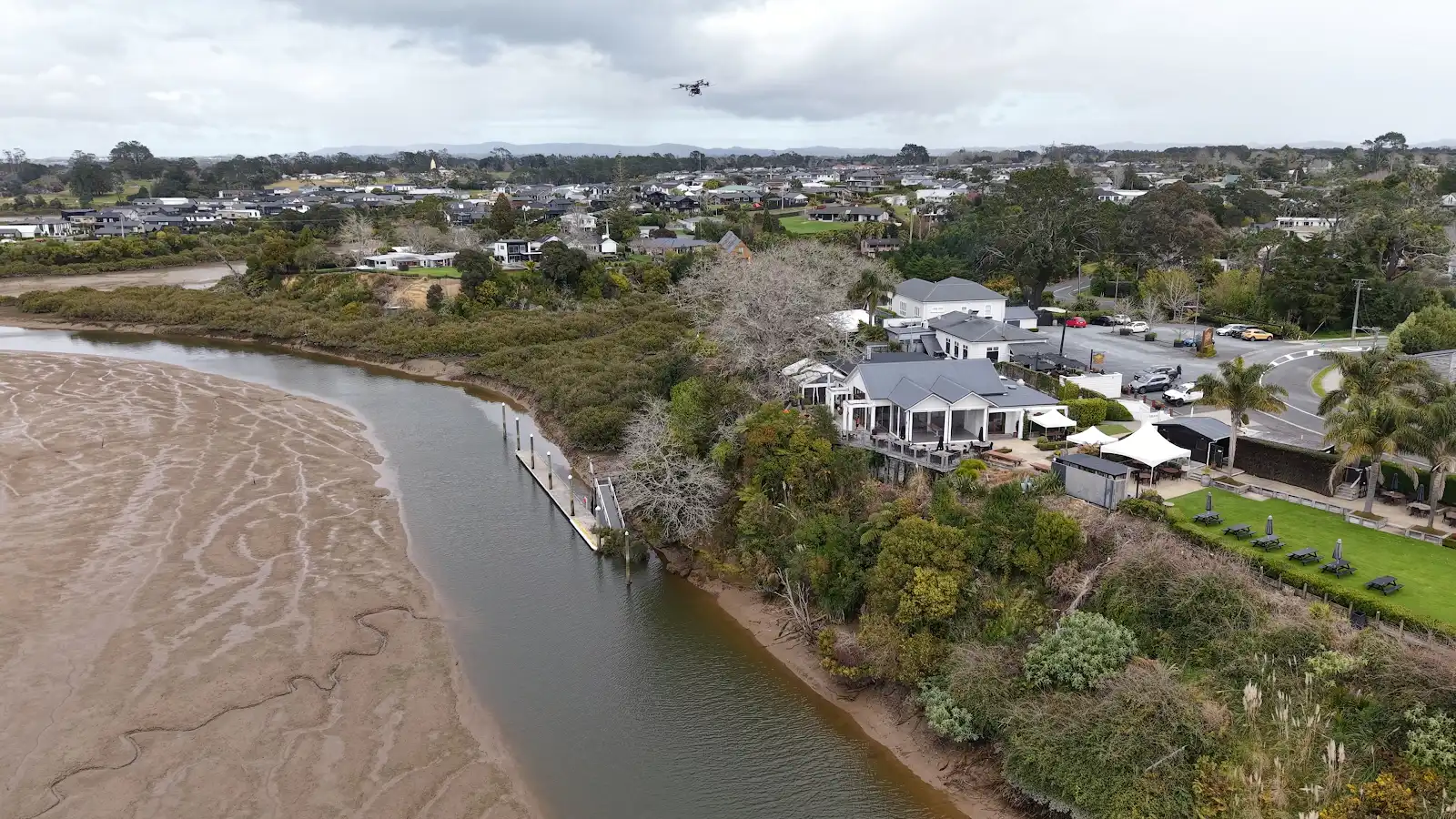
The tree itself could be climbed and dismantled safely. The difficult part was getting the material out.
Using conventional methods, every branch would have needed to be rigged and lowered to the ground, carried up several sets of stairs that zigzag towards the tavern, taken along the side of the deck and then moved up to our truck and chipper. That would have meant far more handling, fatigue, disruption and time through a busy waterfront venue.
So we tried something different.
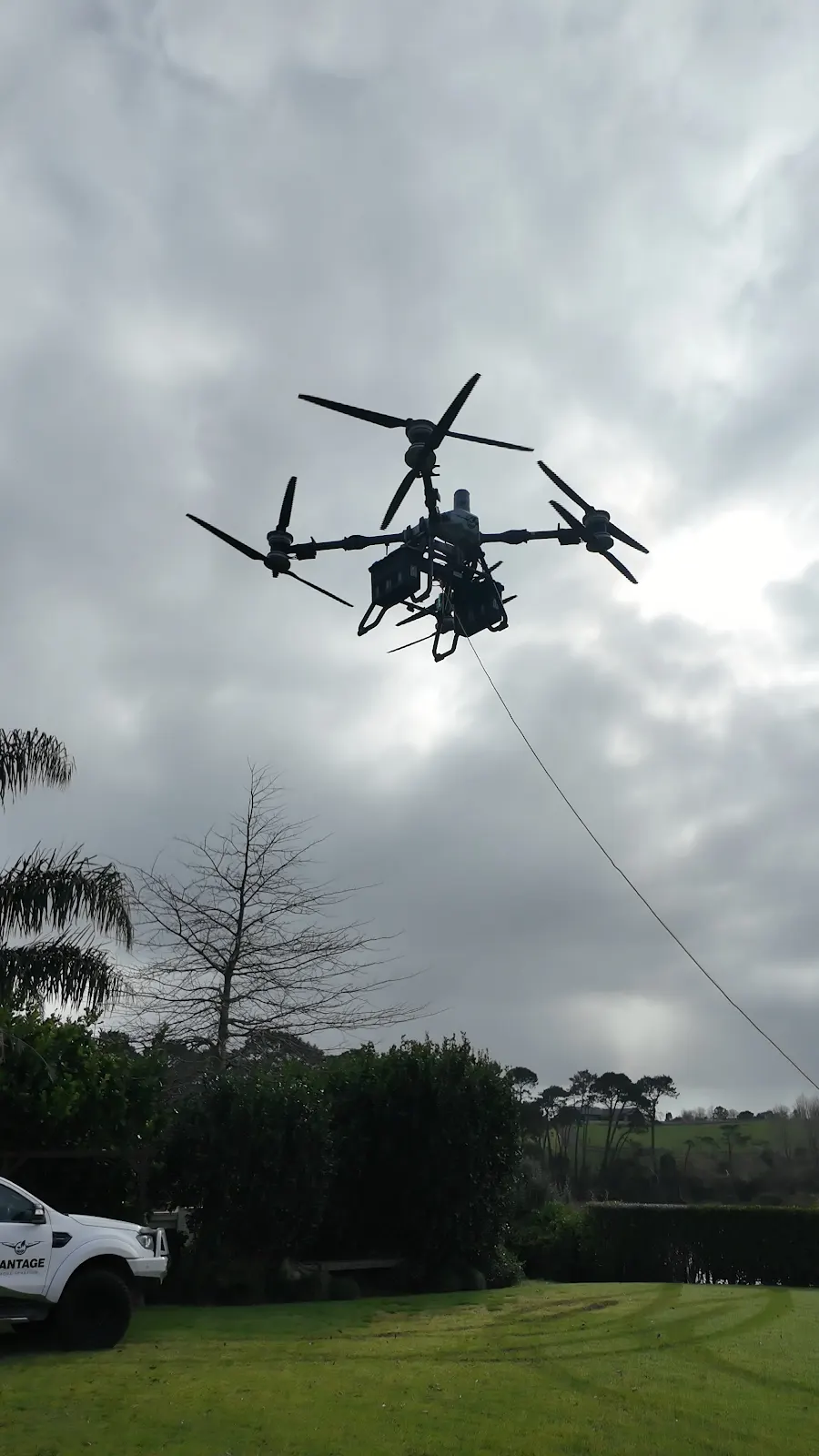
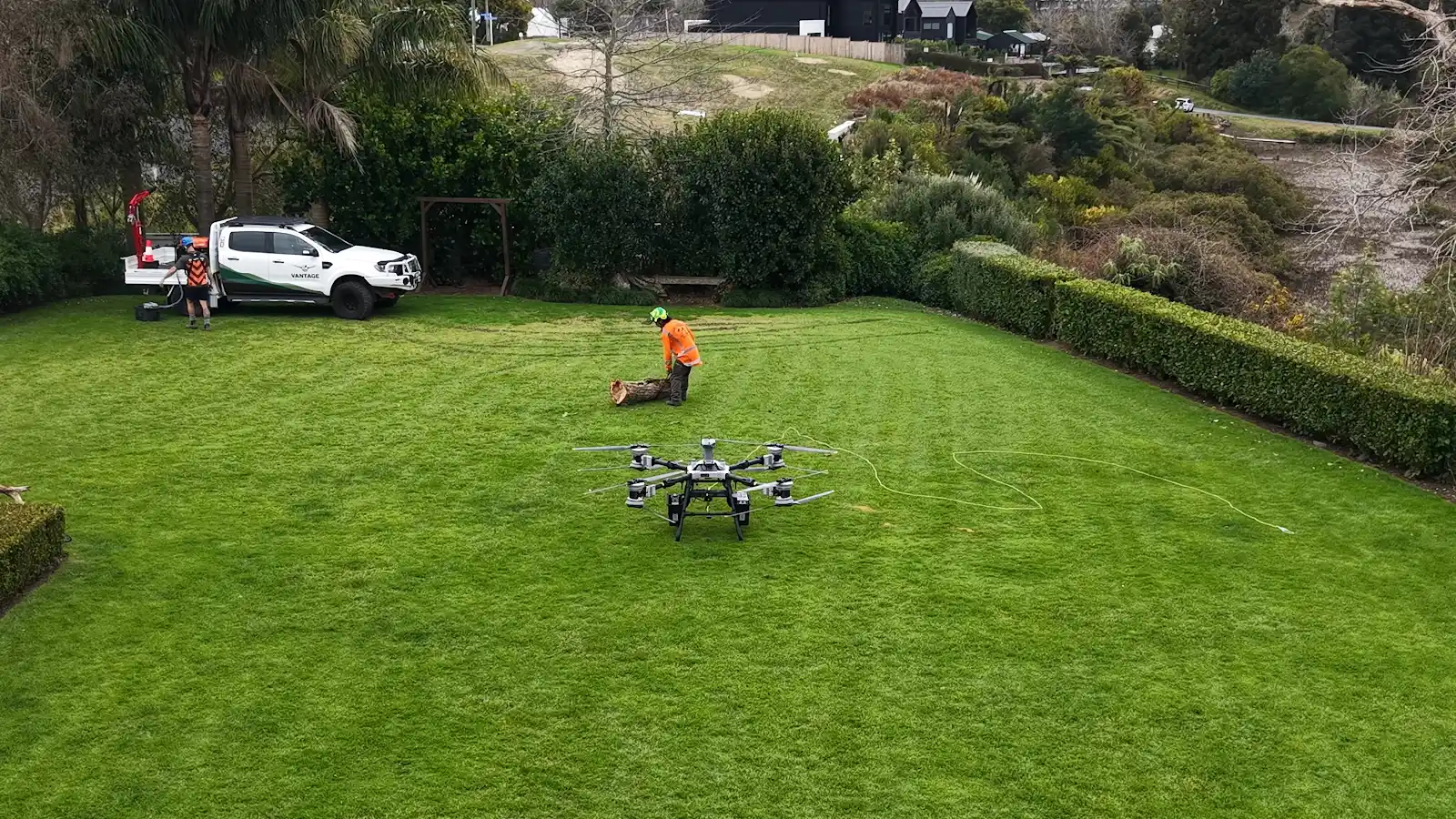
Working with Ben from Vantage Drone Services, Hardfell used a DJI Agras T100 heavy-lift drone to carry sections of the oak directly from the tree to the processing area beside the chipper.
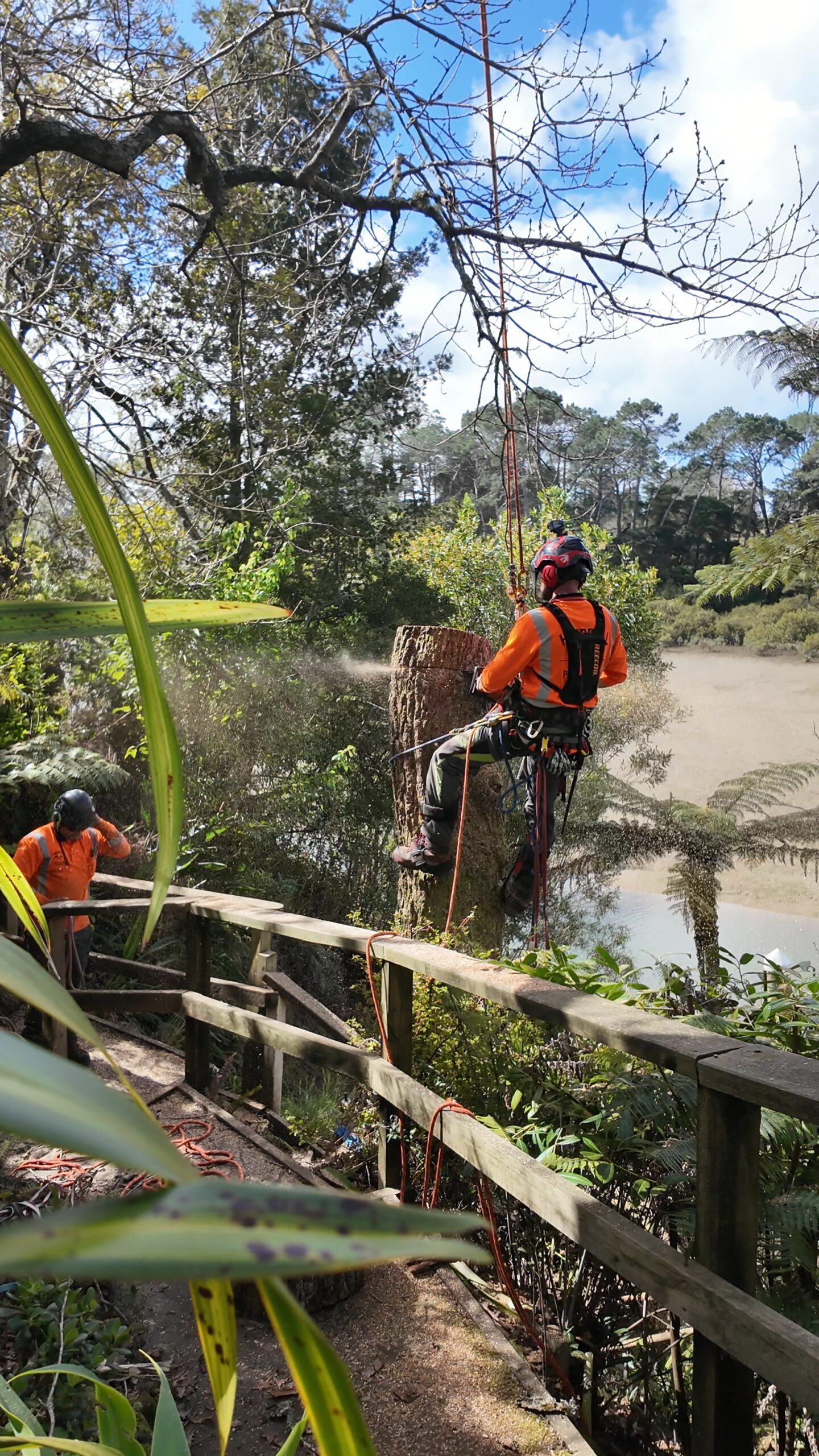
Our climber, Steve, stropped each section, completed the cut and coordinated the release with the drone pilot and ground team. Once free, the drone lifted the section clear and flew it directly to our truck and chipper. Timber rings that were too awkward to sling individually were cut to suitable sizes, placed into lifting bags and flown out afterwards.
To the best of our knowledge, this may be the first documented example of a tree being dismantled and extracted using a drone in New Zealand. We have not found an independently verified earlier example, so we are describing it as a possible New Zealand first rather than a confirmed record.
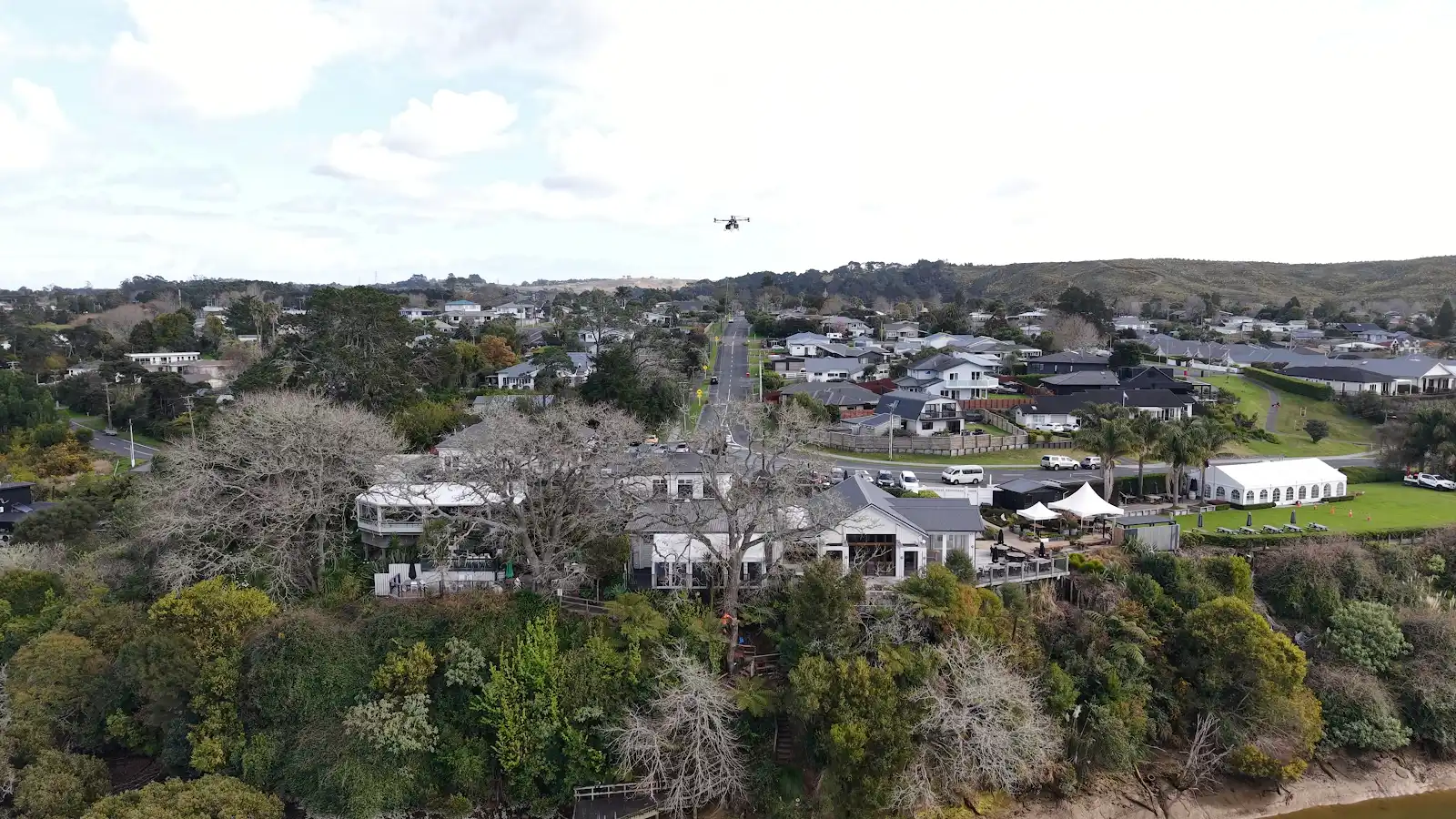
How the Riverhead drone-removal trial came together
Hardfell had originally priced and planned to remove the dead oak using conventional climbing, rigging and manual extraction methods.
A few days before the booked removal, Ben contacted us and asked whether we had any upcoming tree jobs that might suit a heavy-lift drone. Ben is a former Auckland arborist who had previously worked with Hardfell before moving out of the region and establishing his drone business. He is also a friend of ours, so we were fortunate that he thought of Hardfell when looking for a suitable real-world tree job on which to trial the lifting system.
His arboricultural background made the conversation much easier. Ben already understood how a tree is dismantled, how sections behave when released, the importance of suitable attachment points and the need for close coordination between the climber, pilot and ground crew.
The Riverhead Tavern oak immediately stood out because the cutting itself was only one part of the challenge. The real difficulty was the distance and route required to move every branch and timber section to the truck and chipper.
The manual route included several sets of stairs that zigzagged towards the tavern, an area beneath an awning, nearby customer seating and the side of the deck. Repeatedly carrying and dragging material through those areas would have been slow, physically demanding and created additional opportunities to damage the tavern or its outdoor furniture and structures.
Ben and Shaun visited the site together before the job. We assessed whether the drone would provide a genuine advantage and developed a plan covering:
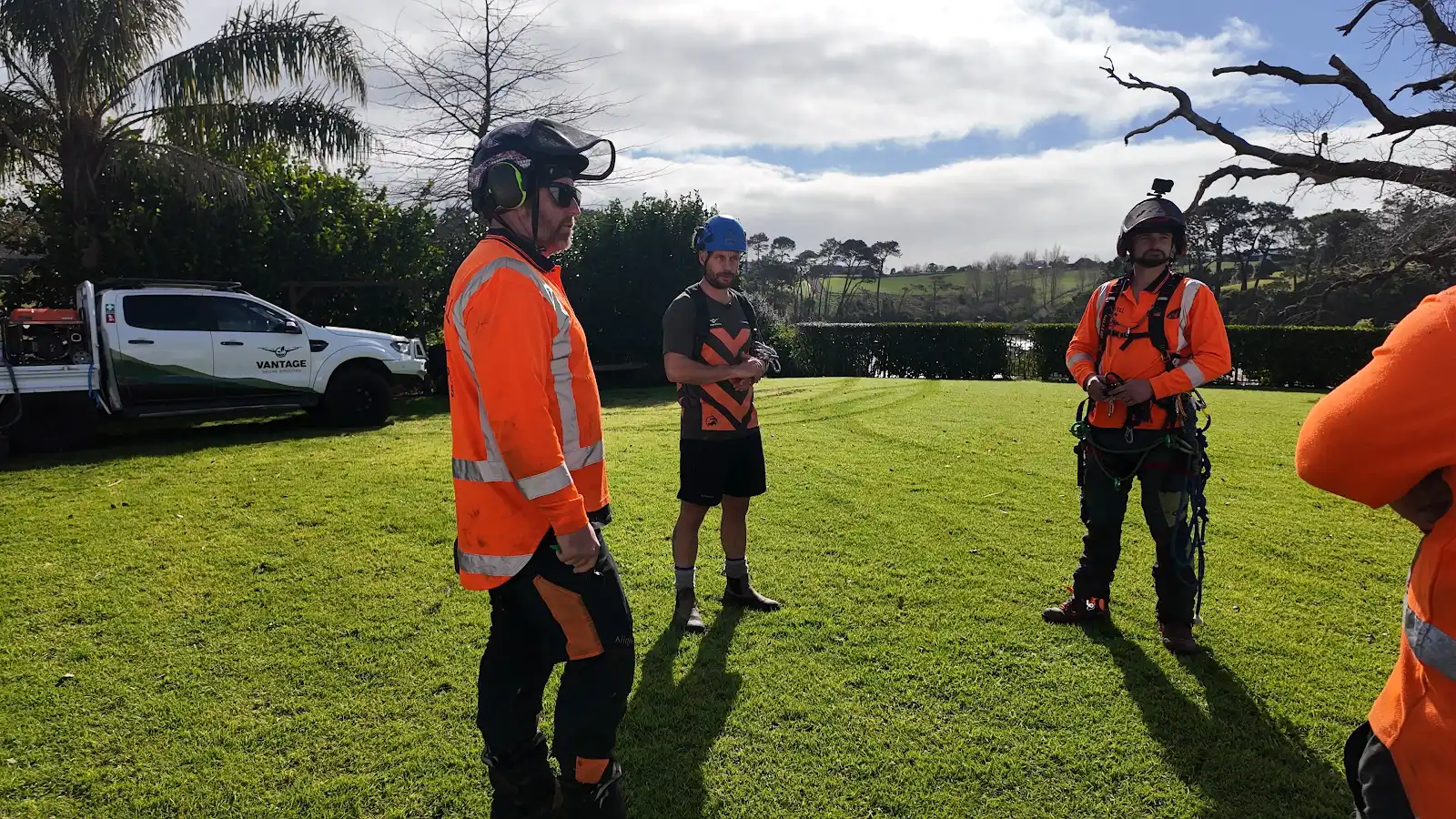
- The sections and approximate weights the drone could safely lift
- The flight path from the oak to the processing area
- Clearance from the tavern, awning, seating, deck and surrounding trees
- The landing point for the branches and timber
- The position of the truck and chipper
- Exclusion zones and communication between the pilot, climber and ground crew
- How awkward timber rings would be contained and lifted
The purpose was not to use a drone simply for the sake of it. The site inspection showed that a direct aerial extraction route could remove most of the difficult manual carry and reduce the exposure of the tavern’s structures and seating areas to damage.
Riverhead Tavern case study results
| Measure | Conventional plan | Drone-assisted result |
|---|---|---|
| Material route | Lower to ground, carry up zigzagging stairs, beneath the awning, past seating and along the deck | Fly directly from the tree to the truck and chipper area |
| Expected job duration | Approximately half a day | Completed in under two hours |
| Manual handling | Repeated carrying and dragging over the full extraction route | Substantially reduced |
| Awkward timber rings | Carry or move individually after lowering | Placed into lifting bags and flown out |
| Main benefit | Familiar conventional method | Faster extraction, less fatigue and reduced risk of incidental property damage |
Once the operation was underway, the flight between the tree and processing area was very fast. A job that could reasonably have taken around half a day using the manual extraction route was completed in less than two hours.
How did the drone tree removal work?
The drone did not cut the tree and it did not replace the arborist.
This was a coordinated dismantling operation involving an experienced climbing arborist, an experienced drone operator working through Vantage Drone Services’ CAA Part 102-certified operating system, and a ground crew.
The basic sequence was:
- Steve climbed into position and selected a section that remained within the planned lifting weight.
- The section was securely stropped to the drone’s lifting line.
- The drone took up controlled tension while the team confirmed the flight path and exclusion zones.
- Steve completed the cut.
- The drone lifted the section vertically clear of the canopy.
- Ben flew it directly to the designated landing and processing area near the chipper.
- The crew detached and processed the material before the next lift.
The key benefit was not simply lifting a piece of timber. It was moving that timber over an awkward waterfront site without repeatedly dragging it across the dock, up stairs and through a hospitality area.
As the removal moved into the heavier timber, some cut rings were too awkward to secure efficiently with individual slings. The crew placed those rings into suitable lifting bags, connected the bags to the drone and flew them to the same processing area. This allowed the drone to remain useful beyond the smaller canopy branches.
What drone was used?
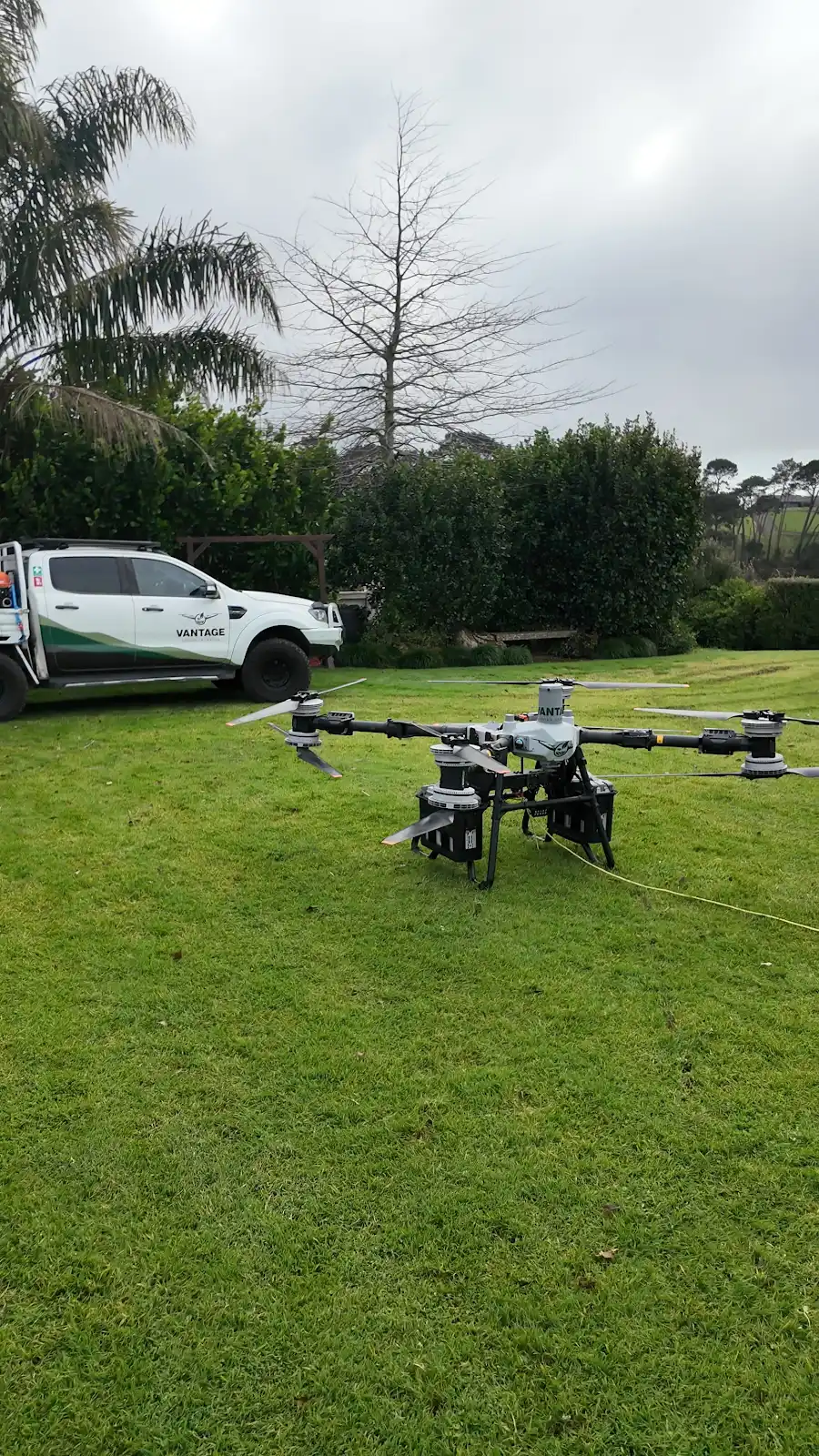
The aircraft was a DJI Agras T100, a large commercial drone platform designed for spraying, spreading and lifting operations.
According to DJI’s official T100 specifications, the standard lifting system has a maximum load capacity of 100 kg. That stated capacity includes the weight of ropes and hooks, and DJI notes that the recommended load can vary with aircraft status, weather, altitude and the task being performed.
That distinction matters. A 100 kg maximum does not mean every branch should be cut to exactly 100 kg. Tree sections are irregular, their weight must be estimated conservatively, and the aircraft needs spare capacity to manage movement, climbing and unexpected load behaviour.
Key DJI Agras T100 lifting specifications
| Feature | DJI specification | Why it matters for tree work |
|---|---|---|
| Standard lifting capacity | Up to 100 kg | Can transport manageable branch and timber sections |
| Dual-battery lifting capacity | Up to 80 kg | Lower payload but longer endurance and an emergency cable-release function |
| Recommended lifting cable | 10-15 m | Helps maintain separation between the load and propellers |
| Wind resistance | Less than 6 m/s | Lifting is weather-dependent and unsuitable in strong winds |
| RTK hover accuracy | Approximately +/-10 cm with strong GNSS | Supports precise positioning, subject to real site conditions |
| Safety sensing | LiDAR, radar and vision systems | Helps identify obstacles, but does not remove the need for a pilot or site controls |
| Integrated weight sensor | Payload weight is measured through the lifting system | Helps the pilot monitor the load and identify an overload |
| Aircraft weight in standard lifting configuration | Approximately 65 kg before payload | Confirms this is specialist commercial equipment, not a camera drone |
Specifications are manufacturer figures. Actual safe payload and performance depend on the aircraft configuration, rigging, site, weather and approved operating procedures.
DJI’s official T100 FAQ also warns operators to avoid strong wind, use an appropriate lifting-cable length and never overload the aircraft.
Does the T100 have onboard scales?
This was one of the most common questions under our Reel.
The T100 lifting system has an integrated weight sensor. DJI’s lifting manual includes a tare-calibration procedure and refers to the measured load displayed through the operating system. The DJI Agras app also recommends a payload limit based on the aircraft’s current status and surroundings.
That provides an important check, but it is not a reason to guess the weight of a branch. Arborists still need to estimate each section conservatively before it is cut. The pilot then checks the aircraft’s measured load and warnings before transporting it.
If the load is too heavy, the correct response is to put it back down and reduce the section. Overloading can cause unstable flight, severe aircraft movement, loss of control or a crash.
Who is Vantage Drone Services?
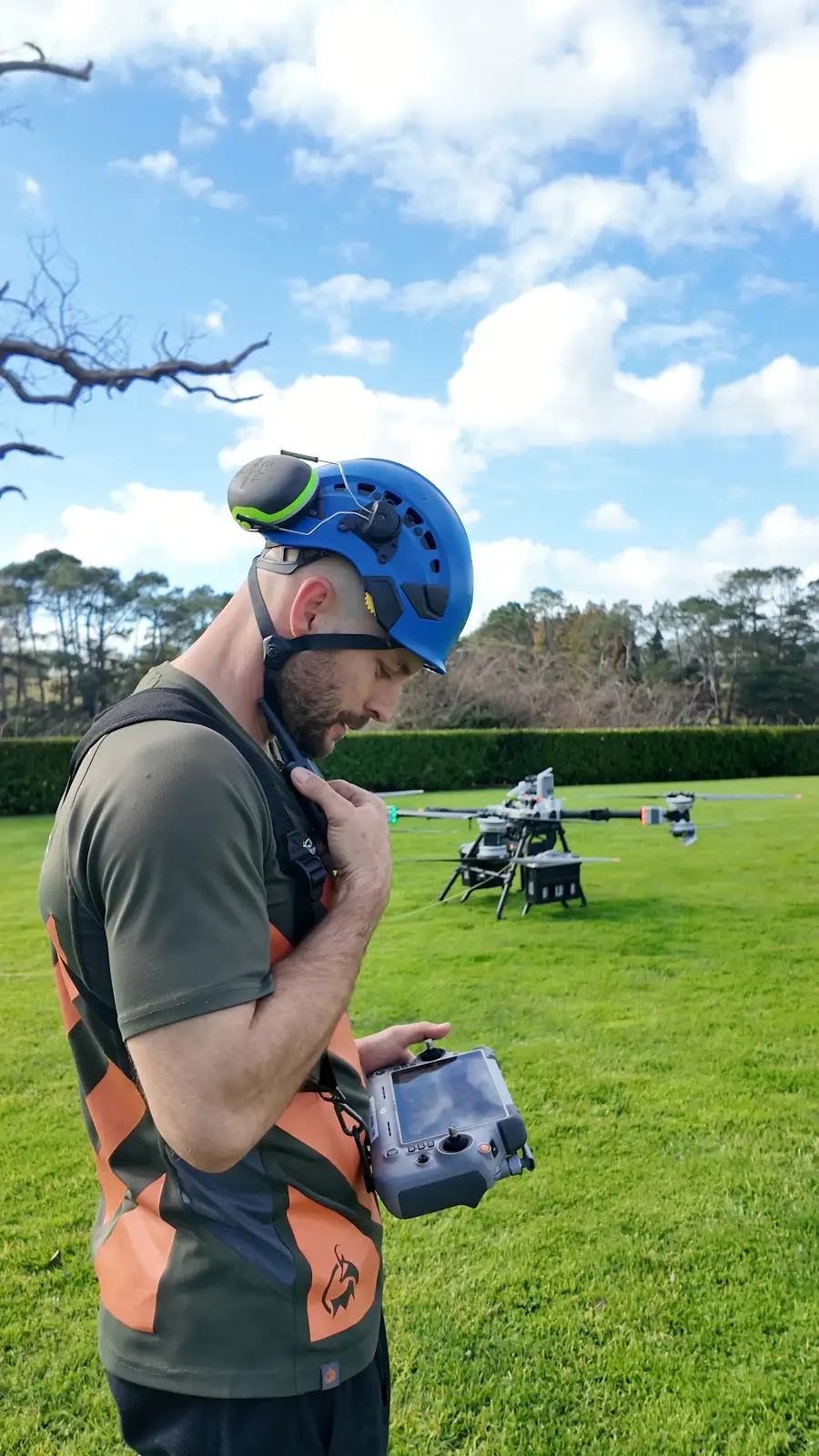
Vantage Drone Services was founded by Ben and Saskia-Rae Janssen. The company operates across the Bay of Plenty and Waikato, with other locations considered by arrangement.
Before starting Vantage, Ben worked as an arborist in Auckland and completed work with Hardfell. That combination of arboricultural experience and commercial drone knowledge was particularly valuable at Riverhead. He understood the tree-work sequence from the climber’s perspective as well as the aviation and payload requirements from the pilot’s perspective.
Its work includes commercial and agricultural drone spraying, spreading, waterway work and roof treatment. Vantage is also developing lifting and transport applications and describes these as an emerging service. The Riverhead operation was treated as a controlled real-world trial, not a claim that drone tree removal is suitable or commercially available for every job. Vantage lists itself as a CAA Part 102-certified operator, a Tōtika prequalified contractor, and an operator of DJI and XAG commercial drone technology.
That commercial experience was important at Riverhead. Heavy-lift tree work requires far more than owning a capable aircraft. It needs aviation planning, a competent pilot, reliable communication with the arborist and ground team, controlled load handling, suitable weather and a clearly managed site.
Is heavy-lift drone tree removal legal in New Zealand?
Heavy-lift drone operations are specialist aviation activities.
New Zealand’s standard Part 101 rules apply to unmanned aircraft under 25 kg. The Civil Aviation Authority states that operators who cannot comply with Part 101 must operate under Part 102 certification.
The DJI Agras T100 is well above 25 kg in lifting configuration, even before a load is attached. Vantage operates under CAA Part 102 certification.
Part 102 certification is not a blanket approval for every imaginable task. An operator must work within its approved operations specification and procedures. CAA requirements include hazard identification, risk controls, pilot and support-crew competency, aircraft details, maintenance, minimum distances and procedures for handling cargo or dropping items.
For tree work, aviation approval sits alongside normal arboricultural controls such as:
- A documented job plan and risk assessment
- Accurate load estimation and conservative section sizing
- Secure, appropriate rigging and attachment points
- Clear communication between the pilot, climber and ground crew
- Exclusion zones beneath and around the aircraft and load
- Property-owner consent and any required airspace approvals
- Weather limits, including wind and visibility
- Emergency and aborted-lift procedures
- Management of nearby buildings, people, roads, water and overhead services
This is not a technique for an untrained camera-drone operator to experiment with.
Is drone-assisted tree removal safer?
It can reduce certain risks, but it also introduces new ones.
At the Riverhead Tavern, the drone substantially reduced manual handling. Without it, every branch would have been rigged and lowered to the ground, carried up several zigzagging sets of stairs towards the tavern, moved along the side of the deck and then taken up to the truck and chipper. The drone flew the material directly to the processing zone instead, making the extraction substantially faster and reducing fatigue on the crew.
On other sites, a heavy-lift drone could reduce the need to:
- Drag branches across roofs, gardens or sensitive surfaces
- Carry material up steep banks or long stairways
- Move heavy machinery across soft ground or root zones
- Set up large cranes where access or working space is limited
- Rig branches through obstacles when there is a clear aerial extraction path
However, a drone does not make tree removal risk-free. New hazards include rotor wash, load swing, changing wind, cable entanglement, battery management, communications failures and the need to maintain safe clearance from branches, wires and people.
DJI specifically advises against lifting in strong winds and warns that long or short lifting lines can create different hazards. A short line can allow a swinging load to approach the propellers, while an excessively long line can contact the ground or become tangled in trees or wires.
The safest method is always the one selected for the actual tree, site and conditions. Sometimes that will be a drone. Sometimes it will be traditional rigging, a crane, an EWP or a controlled dismantle with ropes.
Will drones replace climbing arborists or cranes?
No – at least not with the current technology.
The drone is a transport and lifting tool. It still relies on arboricultural judgement and, in this case, a climber in the tree.
Steve had to assess the dead oak, select suitable cuts, estimate section sizes, install the strops and release each piece at the correct moment. The drone could then move the section, but it could not make those tree-specific decisions.
The T100’s 100 kg maximum lifting capacity is also much lower than the capacity of many cranes. Large stems and heavy timber may still require conventional rigging, mechanical handling or a crane.
The most realistic future is not drones replacing arborists. It is experienced arborists adding drones to the toolbox for the jobs where they provide a genuine advantage.
Where could heavy-lift drones help with future tree work?
The Riverhead job showed how useful aerial extraction can be when the cutting area and processing area are separated by difficult access.
Potential future arboricultural applications include:
Waterfront and coastal properties
Branches could be moved over docks, retaining walls or water without being dragged through buildings or landscaped accessways.
Steep banks and gullies
Smaller sections could be flown uphill to a safe processing area, reducing strenuous manual hauling and the need to place machinery on unstable ground.
Sensitive gardens and tree root zones
Aerial extraction could reduce ground disturbance, compaction and damage to lawns, planting or protected root areas.
Courtyards and enclosed commercial sites
Where a crane cannot get close and the normal extraction path passes through occupied buildings, a drone may provide another option if there is a safe aerial route.
Storm-damaged and compromised trees
On carefully selected jobs, a drone could help move smaller unstable sections away from structures or inaccessible terrain. The condition of the tree, weather and ability to attach the load safely would remain critical.
Conservation and remote work
Heavy-lift drones may help deliver arborist equipment, pest-control gear, seedlings or other supplies into terrain that is difficult to reach on foot or with vehicles. Vantage is already developing drone lifting and transport services for precision logistics.
Rope and access-line installation
Smaller drones are already useful for inspection and line placement. Larger platforms could extend the range of equipment that can be moved into position, subject to approved procedures.
What are the current limitations?
Drone-assisted tree removal will not suit every site.
The main limitations are:
- Payload: 100 kg is significant, but large tree sections can exceed it very quickly.
- Wind: Branches have a large surface area and can swing or rotate even when their weight is within limits.
- Tree canopy complexity: Fine branches and climbing ropes create entanglement hazards.
- Overhead services: Power lines and other wires require strict separation and may rule out the technique.
- Load estimation: Timber weight varies with species, diameter, length, moisture and decay.
- Flight path: The load needs a controlled route to a suitable landing or processing area.
- Noise and exclusion zones: A large eight-motor commercial drone requires space and disciplined site control.
- Regulatory requirements: Operations need to comply with the operator’s CAA approvals and any site-specific permissions.
- Specialist mobilisation: The drone, batteries, charging system, pilot and support crew all need to be planned into the job.
The technology is promising, but it must be used because it improves the job – not simply because it looks impressive.
Frequently asked questions about drone tree removal
Can the DJI Agras T100 really lift 100 kg?
DJI specifies a maximum 100 kg capacity for the standard T100 lifting system. That figure includes ropes and hooks. Actual recommended payload can be lower depending on weather, altitude, aircraft status and the shape and movement of the load.
Does the drone weigh each piece?
Yes. The T100 lifting system incorporates a weight sensor, and its measured value can be checked through the operating interface. The system can also recommend a payload limit for the current conditions. This supports the pre-lift assessment – it does not replace careful section sizing by the arborist.
What happens if the drone is overloaded?
The load should be returned to a safe position and reduced before flight continues. DJI warns that overloading can cause shaking, an inability to stabilise and potentially a loss of control. The 100 kg figure is a maximum manufacturer rating, not a target for every lift.
Did the drone cut the tree?
No. Hardfell climber Steve stropped and cut the oak into planned sections. The drone lifted and transported the released pieces to the processing area.
Why use a drone instead of ropes?
The main issue was extraction. Conventional removal would have required sections to be rigged and lowered, carried up several zigzagging sets of stairs towards the tavern, moved along the side of the deck and then taken up to the truck and chipper. The drone provided a direct aerial route to the processing area.
Where was the drone taking the branches?
Directly to the designated processing area beside the truck and chipper. That avoided the long manual route up the stairs, towards the tavern and along the side of the deck.
Why not just throw the smaller branches into a skip?
Throwing tree sections is not controlled removal. At this site, timber was being handled around a dock, water, a commercial venue and surrounding property. The purpose of the drone was to keep each section controlled and move it directly to the processing area without dragging, dropping or throwing it across the site.
Also, the size of a piece on video can be deceptive. Oak is dense, and the weight includes the complete section plus its rigging. The team still had to select pieces that were appropriate for the aircraft and the site.
Was this New Zealand’s first drone tree removal?
We believe it may have been the first documented example of a tree being dismantled and extracted by drone in New Zealand. We have not found an independently verified earlier example, so we describe it as a possible New Zealand first.
Can the drone lift an entire tree?
No. The T100 has a maximum standard lifting capacity of 100 kg, including rigging. Trees must be dismantled into suitable sections, and larger timber may still need ropes, machinery or a crane.
How were the bigger pieces removed?
The heavier timber was cut into rings that remained within the planned payload. Where those rings were too awkward to secure with individual slings, the crew placed them into lifting bags and the drone flew the bags directly to the truck and processing area.
Anything outside the aircraft’s safe payload still needs to be made smaller or removed using conventional rigging, lowering systems, machinery or a crane. The drone does not change the weight of the timber – it provides another controlled way to move appropriately sized pieces.
Can the drone operate in any weather?
No. DJI lists wind resistance below 6 m/s and does not recommend lifting operations in strong winds. Rain, visibility, temperature and local site conditions also affect whether a lift should proceed.
Does obstacle avoidance make it completely safe around trees?
No. The T100 uses LiDAR, radar and vision systems, but DJI notes that sensing performance varies and wires or other linear obstacles may need to be marked. A skilled pilot, safe separation and an effective job plan remain essential.
Is drone tree removal cheaper?
It depends on the site. A drone may reduce labour, manual handling, site disruption or the need for larger machinery on some jobs. It also requires specialist equipment, an approved pilot and additional planning. The best method should be selected after assessing the whole job.
Was the drone method faster than normal tree removal?
On this particular site, yes. It was substantially faster than the practical manual alternative.
Each flight required the section to be selected, stropped, checked, cut, lifted, flown to the processing area, landed and detached. That controlled cycle can be slower than throwing material into an open work zone. Its value becomes clearer when the conventional alternative involves repeated lowering, dragging, carrying, additional labour or moving material through a sensitive or occupied area.
At Riverhead, the alternative was to rig and lower every branch to the ground, manually carry it up several sets of zigzagging stairs, pass beneath an awning and near seating areas, continue along the side of the deck and then move it up to the truck and chipper. Flying it directly to the processing area removed most of that extraction route. It saved considerable time, reduced physical fatigue and reduced the opportunity for incidental damage around the tavern.
We had expected the conventional removal and extraction to take approximately half a day. With the drone, the work was completed in less than two hours. That does not mean a drone will halve the time on every tree, but it demonstrates the value of aerial extraction when the normal material route is the main constraint.
The right comparison is the entire job – including access, manual handling, property protection, disruption and clean-up – rather than the seconds taken for one branch to reach the ground.
How long did the Riverhead Tavern tree removal take?
The drone-assisted removal was completed in less than two hours. We had expected the same job to take approximately half a day using conventional lowering and the long manual extraction route.
Does insurance cover a heavy-lift drone flying over buildings?
We cannot comment on the details of an individual operator’s insurance policy. Heavy-lift commercial work requires specialist aviation and liability arrangements, and a normal recreational-drone policy should not be assumed to provide the necessary cover.
For any proposed job, the client and principal contractor should verify the operator’s current insurance and ensure it is appropriate for the aircraft, lifting activity and particular site. The flight path should also be planned to avoid people and minimise exposure over buildings or other property wherever practicable.
How much does a DJI Agras T100 cost in New Zealand?
DJI does not publish a single New Zealand package price because the aircraft can be configured with different batteries, chargers, spraying, spreading and lifting equipment.
Broadly, a complete commercial T100 setup represents an investment well into the tens of thousands of dollars. The final figure depends on the aircraft package, number of batteries, charging equipment, lifting system and other accessories. Prices and package contents also change over time.
The real operational investment can also include additional batteries, charging or generator equipment, maintenance, pilot training, Part 102 certification and exposition work, insurance, transport and support crew.
How much does a drone-assisted tree removal cost?
There is no useful flat rate. Pricing depends on mobilisation, pilot and support crew, aviation planning, airspace, site controls, weather risk, the number of lifts and the arboricultural work required. A drone is most likely to make commercial sense where it avoids a costly extraction route, reduces disruption or provides access that would otherwise require significantly more labour or machinery.
Is this the future of tree work?
For every tree? No.
For the right tree in the right location? Very possibly.
The Riverhead Tavern oak showed that heavy-lift drones can solve an access and material-handling problem in a way that conventional methods cannot easily match. They will not replace skilled arborists, rigging systems or cranes, but they may change how we approach difficult waterfront, hillside, remote and restricted-access tree work.
The exciting part is not simply that a drone can lift a branch. It is that arborists now have another way to move material safely and efficiently across sites that were previously difficult to service.
That is where the real future of drone-assisted arboriculture begins.
For another example of aerial extraction, see our Coatesville helicopter tree removal case study.
Need help with a difficult or restricted-access tree?
Hardfell provides technical tree removal, tree pruning and specialist arboricultural services across Auckland. Our team plans each job around the tree, site access, surrounding property and the safest available work method.
If you have a hazardous tree, waterfront property, steep site or difficult extraction route, contact Hardfell for an assessment and quote.